Over the past 30 years, I have worked with many organizations across manufacturing, healthcare, energy & utilities, financial services, logistics, telecommunications, and government sectors. One challenge has remained remarkably consistent regardless of industry: organizations struggle to modernize their applications fast enough to keep up with business demands.
Many of these applications were built years, sometimes decades, ago. They continue to perform critical business functions and often represent millions of dollars of investment. The challenge is that very few organizations can afford to completely replace them yet maintaining them becomes more difficult every year.
During my time building and scaling technology companies, I repeatedly saw the same pattern. Modernization initiatives would begin with great enthusiasm. Consulting firms would estimate multi-year timelines. Teams would spend months documenting applications before any actual transformation work began. Costs would increase, priorities would change, and projects would frequently lose momentum before delivering meaningful business value.
At the same time, the emergence of Generative AI created a new opportunity. While most organizations were focused on using AI for chatbots and content generation, we began asking a different question:
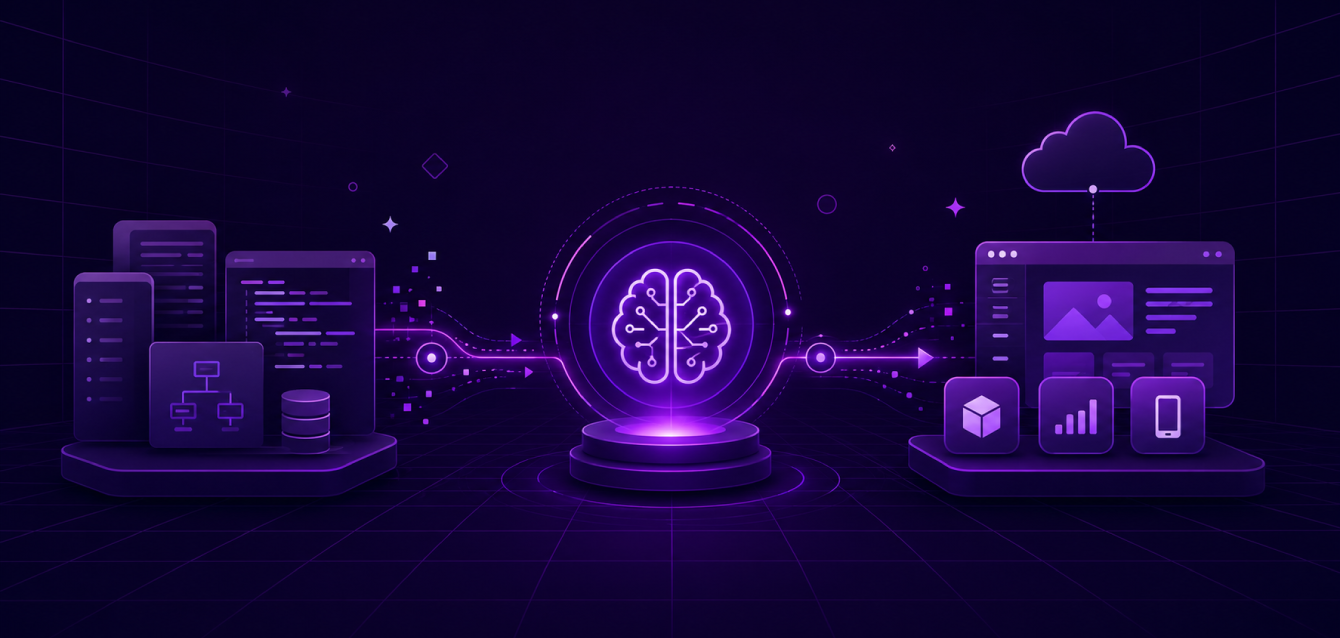
What if software could understand software?
And what if AI could help engineers discover, document, modernize, test, secure, and transform enterprise applications much like an experienced software engineer?
That question became the foundation for Capten.ai.
We formally began development in 2020. Our initial focus was not on Generative AI. It was on solving the fundamental challenge of application understanding. We invested heavily in application discovery, dependency mapping, business rule extraction, automated documentation, and software intelligence. When Generative AI began accelerating enterprise adoption years later, it became a powerful addition to a vision that was already well underway.
Capten.ai was not built to replace software engineers. It was built to make software engineering teams jobs more effective.
One of the biggest challenges in modernization is knowledge. In many organizations, critical business logic exists only in source code and in the minds of a few experienced employees. When those individuals leave, organizations are often left with technical debt – systems that nobody fully understands.
Capten.ai addresses this challenge by helping organizations discover and understand what their applications actually do before making modernization decisions. Instead of treating modernization as a blind code conversion exercise, we focus on preserving business knowledge while accelerating technical transformation.
Another challenge we observed was the amount of time highly skilled engineers spend on repetitive tasks. Documentation, dependency analysis, test creation, security reviews, and impact assessments are essential activities, but they often consume valuable time that could be spent solving business problems.
This is where Agentic AI becomes powerful.
Rather than acting as a simple coding assistant, Agentic AI can perform a sequence of engineering tasks, analyze results, make recommendations, and assist teams throughout the modernization lifecycle. The objective is not automation for the sake of automation. The objective is enabling engineers to focus on higher-value work.
We also recognized that modernization is no longer just about moving applications from one platform to another. Organizations are preparing for cloud-native architectures, intelligent automation, AI-driven workflows, cybersecurity requirements, and increasingly complex integration ecosystems.
As a result, Capten.ai evolved into more than a modernization platform. It became a platform designed to help organizations build the foundation required for the next generation of enterprise technology.
Today, when I speak with CIOs, CTOs, and engineering leaders, the conversation is rarely about technology alone. The discussion is about speed, cost, risk, governance, and business outcomes.
They want to know:
- Can we modernize without disrupting operations?
- Can we reduce technical debt?
- Can we accelerate delivery?
- Can we leverage AI responsibly?
- Can we preserve decades of business knowledge?
These are the problems Capten.ai was designed to address.
The future of software engineering will not be humans versus AI. It will be humans working alongside intelligent systems that amplify their capabilities.
Organizations that embrace this model will innovate faster, modernize more effectively, and create sustainable competitive advantages.
The AI revolution has accelerated what’s possible, but our mission remains unchanged: help organizations understand what they have, preserve the knowledge embedded within their applications, and modernize with confidence.
That vision started in 2019, continues today, and will guide the future of Capten.ai.